A wellbeing assistant with memory
Contextual emotional support with retrieval over the brand's own wellbeing resources, Llama 2 responses and conversation memory for continuity across sessions. Positioned honestly as consumer wellbeing, not clinical treatment.
[cite · brand guide]Where the pain concentrates
The brief was a consumer wellbeing assistant, not a clinical treatment system. That distinction had to show up in the design, in the guardrails and in the way the assistant handled the limits of what it could usefully say.
Context loss between sessions
A returning user had to re-establish what they already told the assistant last week. Not an assistant, a quiz.
Hallucinated advice
A general-purpose model answering wellbeing questions could easily drift beyond what was useful or safe. Not a feature failure, a user safety concern.
Grounding against brand resources
The brand had its own wellbeing material. The assistant's responses needed to be grounded in it, not in a model's general training.
Safety boundaries
The assistant had to know what it was and what it was not, and stay inside that boundary without surprising the user.
What the product team actually said
Grounded, remembering, bounded
The design decision came first: this is a consumer wellbeing assistant, not a clinical treatment system. That boundary had to show up in product copy, in retrieval choices and in the output guardrails, consistent across all three. A system that drifts between those three loses the user's trust the first time it over-reaches.
ScroBits built the full stack: Sentence Transformer embeddings over the brand's own wellbeing content; Llama 2 as the generation model (chosen for latency and privacy); Pinecone-backed conversation memory keyed by user; and explicit output guardrails that keep the assistant inside its intended scope with a clear redirect when a question falls outside.
What runs today is a wellbeing assistant that remembers the user, grounds responses in the brand's own material and stays inside explicit safety boundaries. Not a clinically validated treatment system, and the product does not pretend to be one.
Retrieval over the brand's wellbeing content comes first. Generation stays in the brand's voice. Memory keeps the user in rhythm. Guardrails hold the line.
Five building blocks, one bounded assistant
Each block has a specific job between the user, the brand's material and the safety scope. Together they make a wellbeing assistant that is useful, continuous and honest.
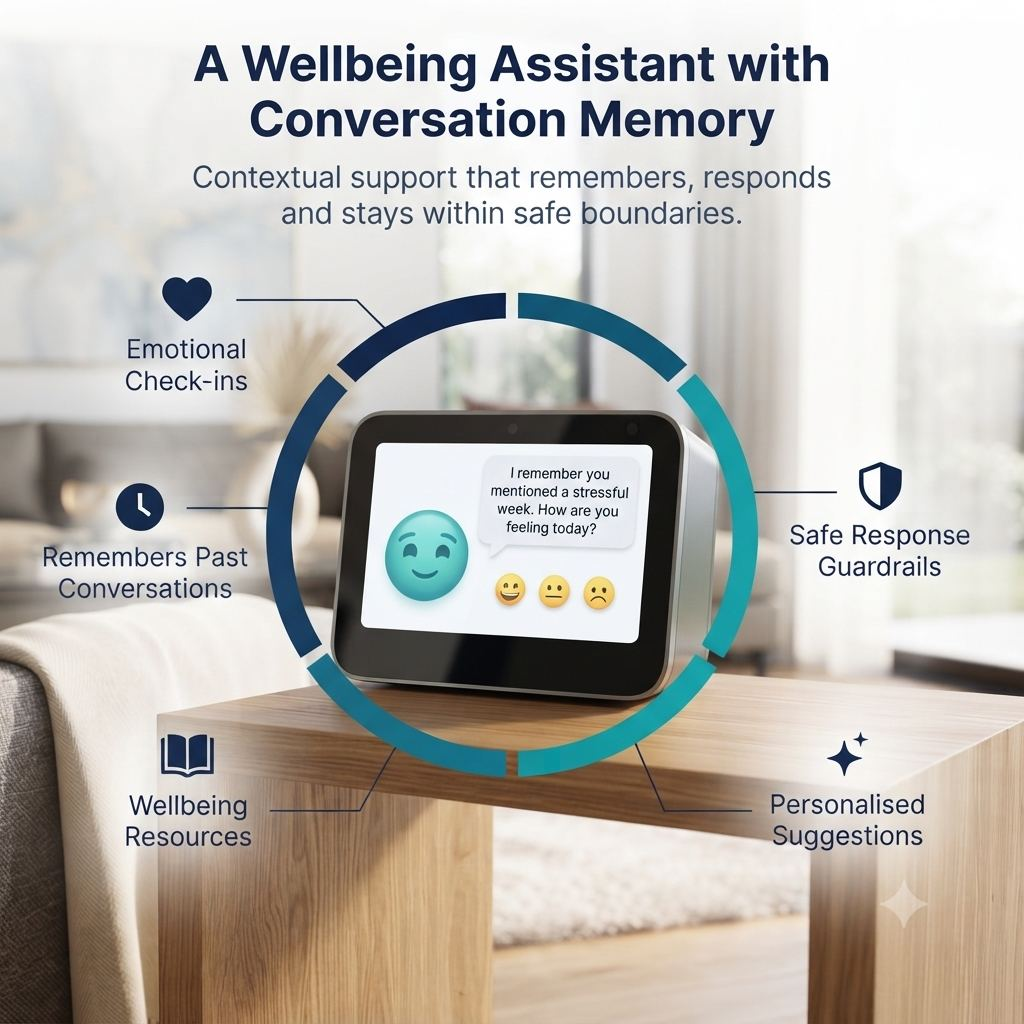
Retrieval over brand resources
Sentence Transformer embeddings over the brand's own wellbeing content. The assistant retrieves brand material first; responses stay in the brand's voice, framings and recommendations.
Llama 2 for generation
Open-weight Llama 2 as the generation model, chosen for latency and privacy fit. Query, retrieved brand resources and relevant conversation history flow into the prompt.
Conversation memory with Pinecone
Pinecone stores conversation history keyed by user. On a returning session, the assistant retrieves relevant prior context so the user does not re-establish what they already shared.
Response guardrails
Explicit output constraints keep the assistant inside its intended scope. Topics outside scope receive a clear redirect. The assistant does not simulate expertise it does not have.
Honest product framing
Positioned as a consumer wellbeing assistant, not a clinically validated treatment system. The boundary is in the copy, in the guardrails and in the escalation surface, consistent across the three.
Query
User asks a wellbeing question in the brand's surface.
Retrieve resources
Sentence Transformers return relevant brand wellbeing material.
Retrieve memory
Pinecone returns relevant prior conversation context for this user.
Compose
Query, resources and memory feed into the prompt as grounded context.
Generate
Llama 2 produces the response, grounded in the retrieved context.
Guardrail
Response passes through output guardrails before reaching the user.
Store
Exchange is written back to conversation memory for future sessions.
Before, after, change
Demonstrates contextual assistance and memory in a consumer wellbeing application. Not a clinically validated treatment system.
| Dimension | Before | After | Change |
|---|---|---|---|
| Session continuity | Each session a cold start | Memory recalls relevant prior context | Continuous |
| Grounding | General model opinion | Retrieval over brand's own resources | Grounded |
| Safety scope | Implicit | Explicit guardrails + explicit product framing | Visible |
| Returning user experience | Re-establish from scratch | Picks up where it left off | Welcoming |
Extending the assistant within its scope
Emotion-aware response pacing
Assistant modulates length and tone based on the user's current state.
Resource recommendation surfacing
The brand's deeper content is reachable from inside the conversation.
Multi-language support
Retrieval serves the brand's material in the user's preferred language.
Caregiver and family handoff
Users who want to share context with a trusted human can do so safely.
Three principles we are taking into the next engagement
Grounding is a safety feature
A general model will drift into advice it has no business giving. Retrieving the brand's own wellbeing material first keeps the assistant in the voice and scope the brand owns.
Memory is not a vanity feature
A wellbeing assistant that forgets the user every session is not an assistant. Pinecone-backed memory lets the assistant stay in rhythm with the user over time.
Framing is part of the product
Positioning this honestly as consumer wellbeing (not clinical treatment) in product copy, in guardrails and in the escalation surface is the design discipline that makes the whole thing responsible.
Shipping a wellbeing experience and want it grounded, remembering and safe?
ScroBits builds the retrieval layer, the memory layer, the generation pipeline and the guardrails. Two weeks to a scoped pilot on your own wellbeing material.