Legal knowledge across connected systems
One assistant across HubSpot, Gong, Google Drive and shared documents. Multi-tenant by design, with legal judgement left where it belongs: with the reviewer.
[cite · HubSpot] [cite · Gong] [cite · Drive]Where the pain concentrates
Four systems, four permission models, four ideas of what counts as a client. A unified search surface that leaked across tenants would be a termination event. A siloed search surface that forced four lookups was already losing hours a day.
Four sources of truth, no shared answer
CRM, call recordings, shared drives, email. A reviewer could search any of them. Crossing two in one query was not supported.
Format drift between systems
A client name appeared differently in HubSpot, Gong transcripts and document titles. Simple joins broke silently.
Multi-tenant risk at every retrieval
A query from Firm A could not surface a sentence from Firm B's matter, even if the embedding said it was similar. A leak would be a termination event.
Judgement had to stay human
Any system that answered a legal question with confidence and was sometimes wrong was worse than the current pain.
What the reviewers actually said
One assistant, four systems, tenant-safe
The platform serves multiple firms with their own matters, clients and confidentiality boundaries. The design decision came first: enforce tenant and role at retrieval, not at presentation, so the model never sees content the user is not entitled to.
ScroBits built the full stack: source synchronisation and format normalisation across HubSpot, Gong, Google Drive and email; a hybrid retriever that chooses between a tenant-partitioned vector index and live direct access through an MCP gateway, per query; an evaluator agent that scores confidence and grounding and offers open-mode disclosure or escalation to a human lawyer.
What runs today is one surface for client context across four systems, with permission enforcement by construction and every retrieval, evaluator decision and escalation logged for audit.
The model never sees content outside the user's tenant or role. The orchestrator refuses cross-tenant answers even on high embedding similarity.
Five building blocks, one governed surface
Each block carries a specific job between the source systems and the reviewer. Together they make a cross-system assistant safe to put in front of regulated legal workflows.
Unified data layer
Source sync keeps HubSpot, Gong and Google Drive current. Format normalisation handles client-name drift so one query reaches all three without being rewritten.
Hybrid retrieval
Semantic match for stable content, live direct access via an MCP gateway for anything that changes by the hour. The orchestrator chooses per query, with provenance preserved.
Multi-tenant isolation
Vector index partitioned by tenant. Direct access carries tenant context on every call. The orchestrator refuses cross-tenant answers even on high similarity.
RBAC at retrieval, not presentation
Permission filter runs before retrieval. The model never sees content the user is not entitled to; a paralegal query returns a paralegal view, by construction.
Evaluator with open-mode disclosure
Low-confidence responses offer open-mode fallback with explicit disclosure, so the reviewer sees when the answer is grounded and when it is reasoning more broadly. Escalation to a human lawyer is first-class.
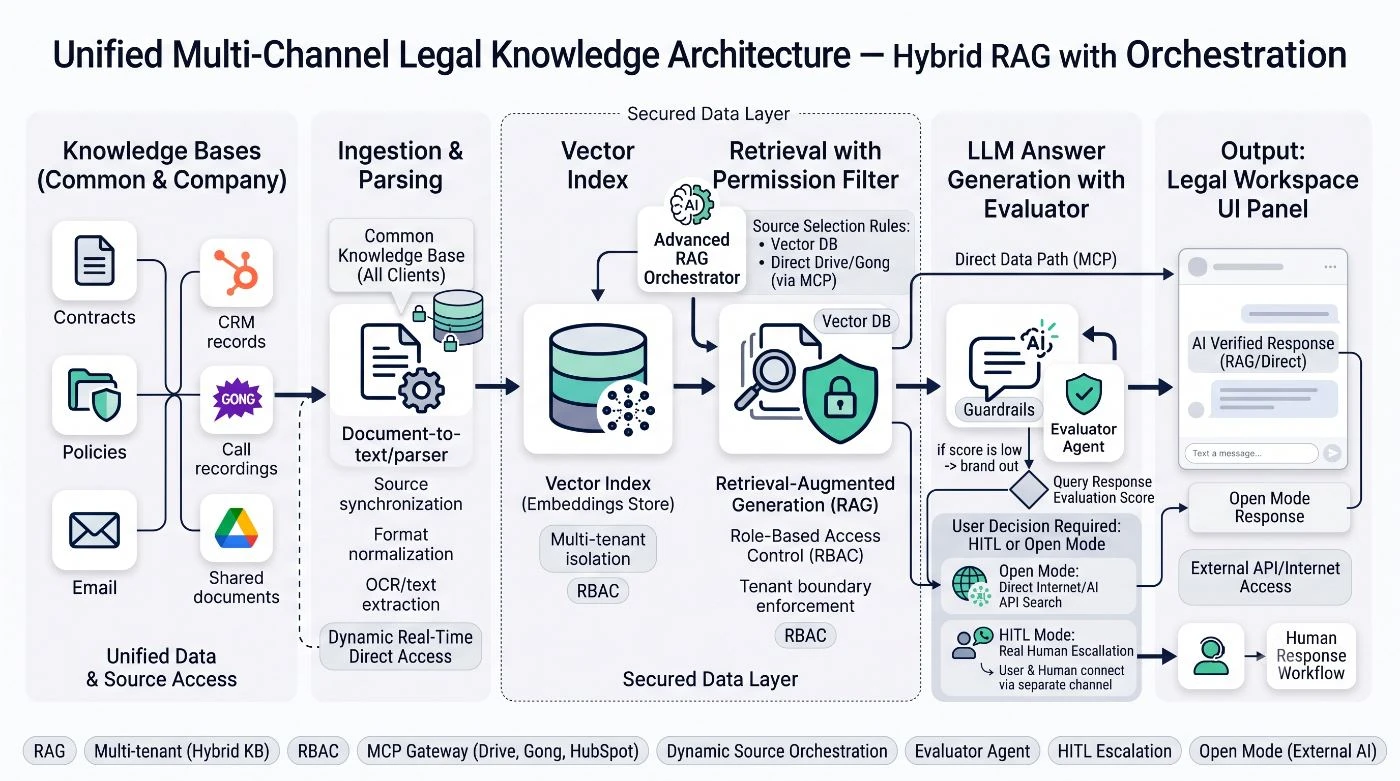
Ingest
HubSpot, Gong, Drive, email. Source sync + format normalisation keep them joinable.
Index
Vector index with tenant + role metadata attached to every chunk.
Scope
Permission filter scopes the search space before retrieval runs.
Retrieve
Orchestrator chooses vector or live direct access through MCP, per query.
Generate
LLM answers. Evaluator scores confidence and grounding in line.
Branch
Grounded answers with citations; low confidence routes to open mode or escalates.
Audit
Every retrieval, evaluator decision and escalation is logged.
Before, after, change
| Dimension | Before | After | Change |
|---|---|---|---|
| Sources searched per client question | 4, manually | 1 assistant, 4 systems reconciled | Collapsed |
| Permission enforcement | After retrieval, by hand | Before retrieval, by RBAC | By construction |
| Confidence disclosure | Implicit | Explicit, open-mode routed | Visible |
| Human escalation path | Ad hoc | First-class in the UI | Standard |
Extending the unified data layer
Matter-level dashboards
Built on the same unified data layer, so a reviewer sees the state of a matter without opening four tools.
Automated conflict checks
Incoming client inquiries screened against the same tenant-aware retrieval.
Citation-level audit trail
Exported to the firm's compliance workflow in the format auditors already consume.
Expanded source coverage
Case management and billing systems joined to the same unified layer.
Three principles we are taking into the next engagement
RBAC belongs upstream of retrieval
Filtering results after the fact leaves the model holding content the user cannot see. Scoping the search space before the query runs is the only safe design.
A hybrid retriever beats one index
Vector for stable content, live direct access for anything that changes by the hour. The orchestrator picks per query, with provenance preserved either way.
Disclosure is a product feature
The reviewer needs to know when the answer is grounded and when it is reasoning broadly. Open mode with explicit disclosure keeps the human in judgement.
Running an assistant across your systems and want it safe to put in front of reviewers?
ScroBits builds the data layer, retrieval, evaluator and governance. Two weeks to a scoped pilot on your real systems.