GRC support with faster ticket investigation
A seven-step multi-agent pipeline across three to four years of historical tickets, documentation and test cases, coordinated through LangGraph. Investigation collapses from 60-120 minutes to 10-15, with cited sources.
GRC-9871, GRC-10112, GRC-10433. Root cause pattern: evaluator cache miss after schema migration. Resolution guide ready, [5 citations].What was breaking before we started
A single GRC incident could touch five systems before anyone decided what to do. The product shipped faster than the team could absorb what shipped, and every new release widened the gap.
The knowledge base was a senior engineer
Routine tickets needed 60 to 120 minutes of context assembly before investigation could start.
Complex tickets depended on tribal knowledge
10 to 11 days to close, because escalation was the only path to the precedent.
Documentation drift
Four systems, different owners, different update cadences. The current answer was in Confluence; the authoritative answer was in a ticket.
Audit expectations were growing
GRC customers expected traceable responses with cited sources, not an opinion.
What support leads actually said
A pipeline, not a single prompt
Three to four years of tickets, documentation and test cases held the pattern of what had broken before. The question was how to make that institutional memory accessible on the first ticket, instead of only through a senior engineer.
ScroBits built an indexed historical corpus and a seven-step multi-agent pipeline on LangGraph. Analysis, validation, retrieval and recommendation each with their own schema and checkpoint. GPT-4 for reasoning-heavy generation, Meta Llama Scout 17B for faster classification, AWS Bedrock as the gateway. Observability (Langfuse, Prometheus, Structlog) installed from day one.
What runs today is a self-serve investigation surface for every support engineer, with 60-120 minute context assembly down to 10-15, 10-11 day complex closes down to 2-3, and a traceable, cited answer on every ticket.
Named agents with explicit input and output schemas, LangGraph for orchestration, Langfuse + Prometheus + Structlog for observability. Debuggable, auditable and improvable by the support team itself.
Five building blocks, one debuggable pipeline
Each block has a specific job in the Analysis -> Validate -> Retrieve -> Reason -> Deliver flow. Together they turn 3-4 years of tickets into accessible precedent.
Indexed historical corpus
Three to four years of Jira tickets cleaned and enriched. SharePoint, Confluence and Zephyr embedded into Weaviate with Cohere embeddings, keyed by product area, release, severity and resolution class.
Seven-step multi-agent pipeline
Analysis, validation, retrieval and recommendation each with their own schema, contract and checkpoint. Not one model answering a question, a pipeline that mirrors how a good support engineer investigates.
LangGraph orchestration
Named agents with defined input and output schemas, visible branching when a step is ambiguous. Debugging a wrong answer means inspecting a graph, not reading a prompt.
Model routing on AWS Bedrock
GPT-4 for reasoning-heavy generation, Meta Llama Scout 17B for faster classification. The right model per step, instead of one large model for every step.
Observability from day one
Langfuse for LLM tracing, Prometheus for latency and errors, Structlog for structured logs across the pipeline. Every ticket's investigation is reconstructable from the traces.
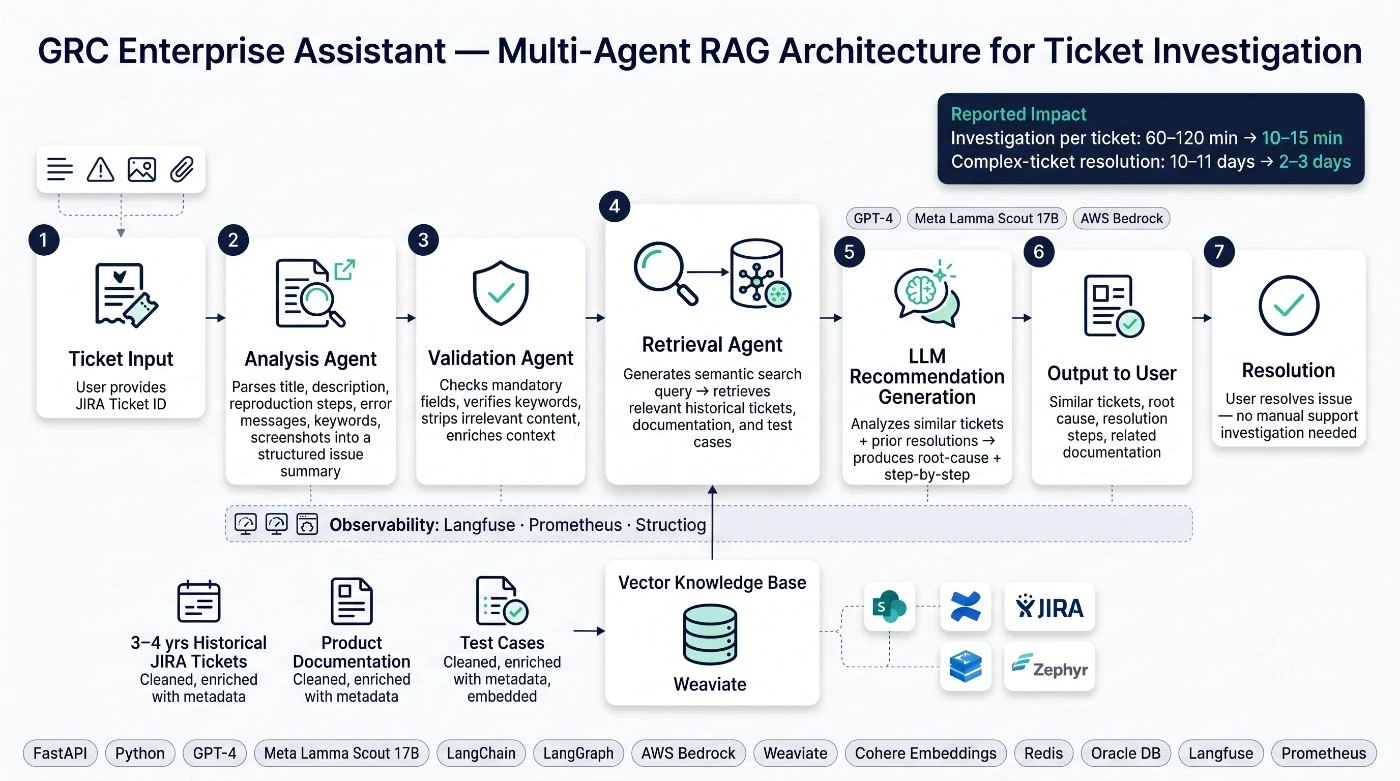
Input
User provides a Jira ticket ID.
Analysis
Parses title, description, repro steps, errors and keywords into a structured issue summary.
Validation
Mandatory fields checked, keywords verified, irrelevant content stripped, context enriched.
Retrieval
Semantic queries over Weaviate pull similar tickets, documentation and test cases.
Recommend
LLM analyses prior resolutions and produces root cause plus step-by-step guidance.
Deliver
Similar tickets, root cause, resolution steps and related docs with citations.
Resolve
User resolves the issue. No manual investigation for the routine class.
Before, after, change
| Measure | Before | After | Change |
|---|---|---|---|
| Investigation per ticket | 60 to 120 min | 10 to 15 min | ~85% faster |
| Complex-ticket resolution | 10 to 11 days | 2 to 3 days | ~75% faster |
| Senior engineer dependency | Primary path for complex tickets | Reserved for genuinely novel cases | Unblocked |
| Sources consulted per ticket | 4, manually | 1 pipeline, 4 systems retrieved | Collapsed |
| Resolution traceability | Narrative in ticket | Full LangGraph trace with citations | Reconstructable |
Extending the retrieval layer
Auto-classification
Ticket severity and routing driven by the same retrieval layer.
Precedent-aware test cases
QA pre-empts regressions the historical ticket base has already shown.
Confidence-scored auto-resolution
Top-N routine ticket classes closed with human approval before close.
Multi-tenant deployment pattern
For GRC vendors with multiple product lines.
Three principles we are taking into the next engagement
A pipeline beats a prompt
Named agents with explicit schemas and checkpoints make the system debuggable. One large model answering everything is a black box the support team cannot own.
Route to the right model per step
Fast classification and heavy reasoning deserve different models. A gateway (AWS Bedrock) made that routing a configuration decision, not a rewrite.
Observability is not an afterthought
LLM tracing, latency and structured logs installed from day one. Every ticket's investigation is reconstructable, which is what the GRC buyer actually wanted.
Sitting on years of tickets and want the pattern on the first ticket?
ScroBits builds the indexing, retrieval pipeline, agent orchestration and observability. Two weeks to a scoped pilot on your historical tickets.