Live health across 500+ diesel gensets, without touching a single controller
A non-invasive edge sensing platform for diesel genset OEMs. Scattered paper logs, dealer phone calls and manual CPCB reports become real-time fleet health, predictive alerts and one-click compliance, across mixed controller brands, patchy rural networks and a three-tier OEM-dealer-customer chain.
Where the pain concentrates
The genset is a backup asset nobody looks at until it fails. Controllers across the fleet come from six to eight different vendors. The sites sit in places where 4G is theoretical. Dealers charge for every truck roll. The compliance paperwork for CPCB IV+ consumes a dealer engineer three days a month per 200-unit zone. Putting a tap on the controller kills OEM warranty on day one.
Eight controller brands, one fleet
ComAp, DSE, Woodward, Cooper and unbranded telecom panels across the same OEM. Controller-first monitoring becomes eight integrations, each with its own protocol and firmware quirks.
Warranty exposure at the controller
Machines under OEM warranty cannot accept a third-party tap on the control panel. Dealers will not sign off on any solution that puts that warranty at risk.
Comms deserts, not networks
Rural telecom towers, ghat-region hotels, tier-3 hospitals. 2G is patchy, 4G is theoretical. Cloud-first architectures drop half the data on the floor.
Compliance done on paper
CPCB IV+ reporting consumes a dealer engineer 8 to 10 person-days a month per 200-unit zone, before a single insight is produced.
What the platform will not do
Non-invasive at the edge, intelligent in the cloud
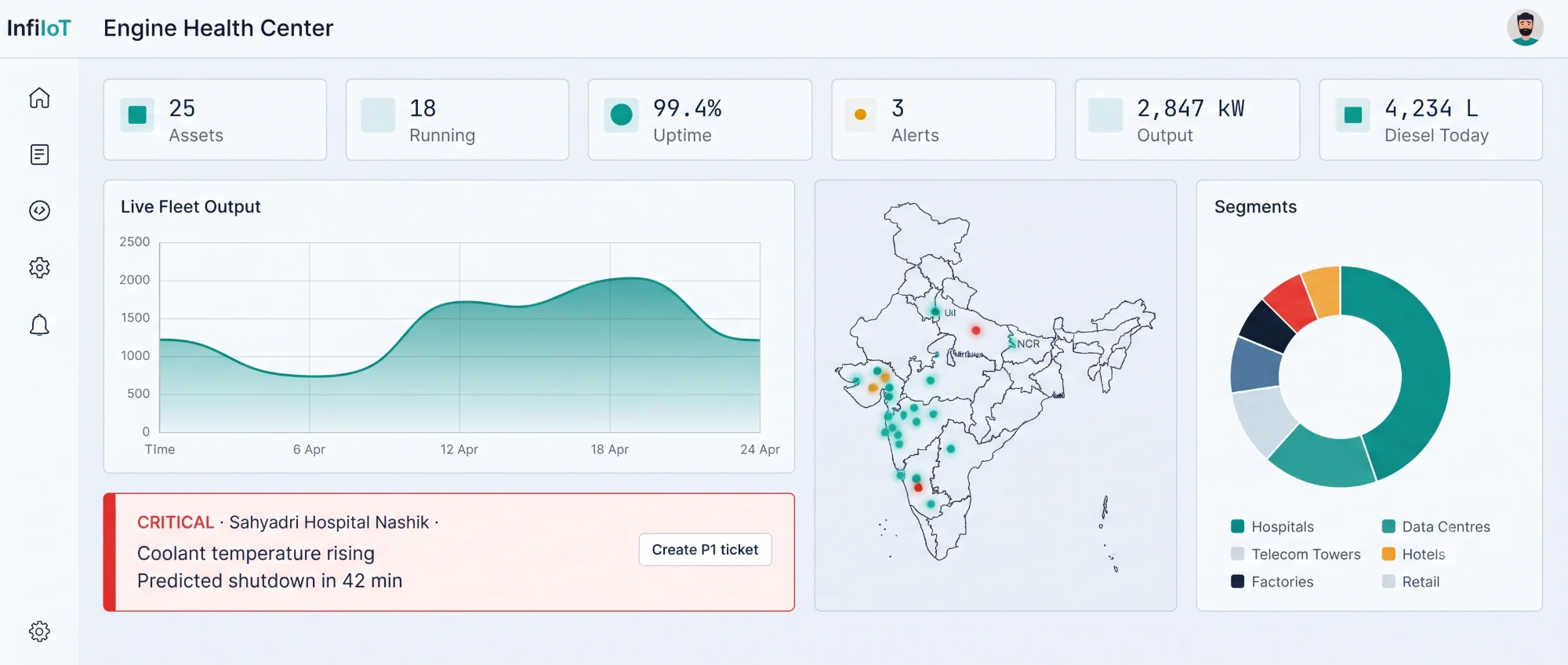
The platform respects the two commercial constraints every OEM has (do not touch the controller, do not break the warranty) and then does the actual work: real-time fleet health, predictive alerts with explanations, auto-ticketing into the dealer network, fuel intelligence, CPCB IV+ compliance on autopilot, and multi-tenant delivery across the OEM-dealer-customer chain.
Sensing is on the output and the fuel line, not the control panel. The gateway buffers seven days locally and replays in order when comms return. Every unit auto-learns its own baseline within 72 hours. Rate-of-change models across 47 sensor streams flag thermal, fuel and mechanical faults 30 to 60 minutes before shutdown, with SHAP attributions the dealer engineer can act on.
The commercial design is as deliberate as the technical one. Dealers do not lose margin. OEMs do not lose warranty exposure. End-customers see the brand they bought from, not ours. The platform works inside the three-tier chain the industry already runs on.
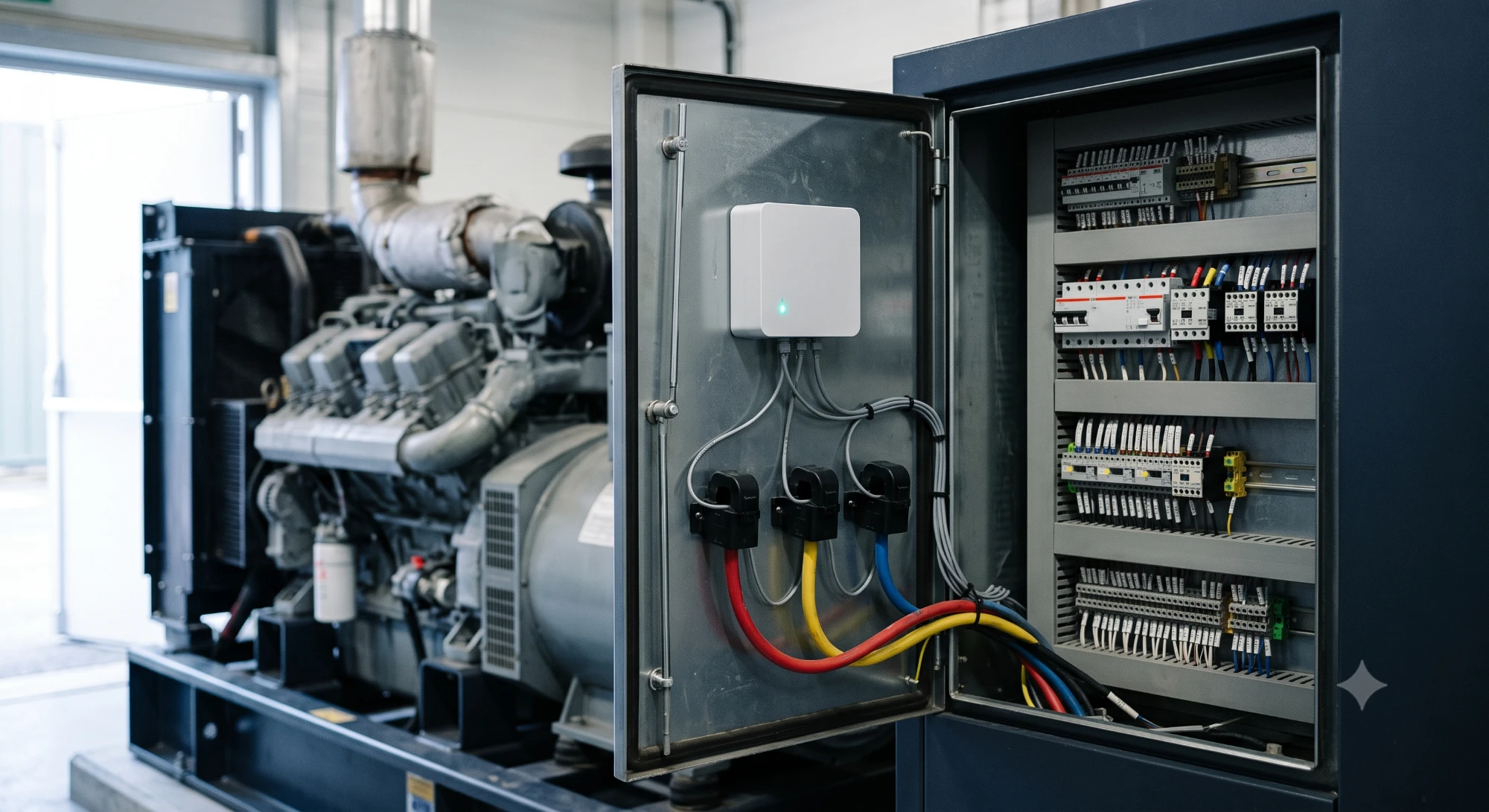
CT clamps on the three-phase output, magnetic pickups on the fuel line, optional read-only CAN only when the OEM explicitly authorises it. The warranty question never comes up.
Six building blocks, one fleet-ready platform
Each block carries a specific job between the genset at the site and the OEM, dealer or end-customer looking at the dashboard. Together they make live fleet health possible without touching a single controller.
Non-invasive edge sensing
CT clamps on the three-phase output, magnetic pickups on the fuel line, optional read-only J1939 CAN tap. Zero connection to the controller. OEM warranty preserved end-to-end. Retrofits install in under two hours.
Store-and-forward edge gateway
Seven-day local buffer on the gateway. 4G LTE primary with 2G fallback. Cloud comms optional, not required. Sites survive week-long connectivity outages without a single lost data point. Data replays in order when comms return.
Learned baselines per genset
Every unit auto-learns its normal signature within 72 hours of commissioning. A 15 kVA telecom unit and a 250 kVA data centre unit get individualised normal, not a fleet-wide static threshold.
Predictive alerts with SHAP explanations
Rate-of-change AI across 47 sensor streams. 43-minute mean lead time on thermal, fuel and mechanical faults. Every alert ships with a feature-attribution breakdown the dealer engineer can act on. Not a black box.
Auto-ticket and dealer routing
Every critical alert auto-drafts a P1 ticket, assigns the nearest authorised dealer engineer, pre-fills the parts list, opens a 4-hour SLA clock and pings the dealer on WhatsApp Business and email. The dealer network keeps its margin.
CPCB IV+ compliance on autopilot
NOx, CO, HC, PM, smoke and noise readings streamed from certified sensors. Monthly compliance PDF auto-generated per site, signed and ready for submission. Dealer compliance visits drop by 90%.
Sense
CT clamps, magnetic pickups, optional read-only CAN tap. No wire goes near the controller.
Buffer
Seven days of local storage. 4G LTE primary, 2G fallback. Replays in order when comms return.
Learn
72 hours after install, each unit has its own signature across load, thermal, fuel and electrical behaviour.
Score
Composite health score per genset, updated every minute. Rate-of-change models flag faults 30–60 min ahead.
Route
Critical alerts auto-draft a P1 ticket, assign the nearest dealer, pre-fill parts, open a 4-hour SLA clock.
Deliver
OEM HQ, dealer and end-customer each see the fleet through their own lens on the same data layer.
Report
CPCB IV+ monthly PDF auto-generated per site from certified sensor streams, ready for submission.
Answer
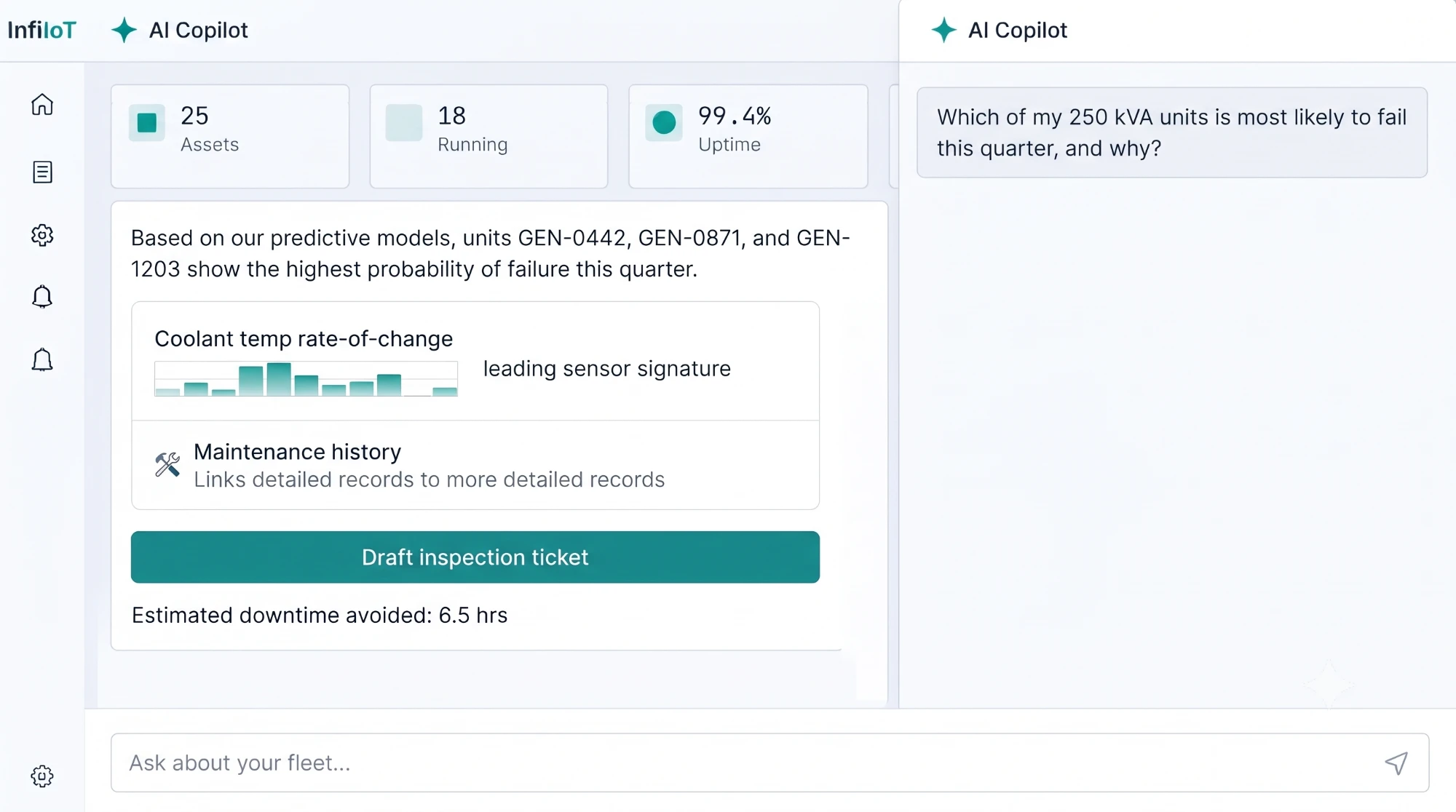
The copilot takes plain-English fleet questions and answers from live data and the model's own attributions.
Typical today, target, change
| Measure | Typical Today | Target | Change |
|---|---|---|---|
| Fleet uptime | 96.2% | 99.4% | +3.2 pts |
| Unplanned downtime (min / genset / month) | 340 | 189 | −44% |
| Time to know a genset is down | 4–8 hours | Under 60 sec | Real time |
| Failures caught predictively | 0% | 71% | From zero |
| Dealer P1 response time | 8h 20m | 2h 15m | −73% |
| Diesel loss to theft (₹ / genset / month) | ₹18,400 | ₹2,100 | −89% |
| CPCB IV+ monthly reporting effort | 3 days / 200-unit dealer | Automated | Eliminated |
| Controller integrations touched | n/a | 0 | Warranty preserved |
Baselines and targets sized from industry benchmarks and validated against the specific fleet during pilot.
Extending the fleet surface
Fleet-wide anomaly clustering
Spot a bad batch of injectors or a weak cooling-system supplier before the warranty claims land.
Dynamic maintenance scheduling
Service intervals computed per unit from actual load and runtime, not a factory schedule meant for the median case.
Spare-parts prediction for dealer stocking
Pre-position the parts the fleet is about to need, by region, by duty cycle, by week.
Grid-tie and hybrid-renewable integration
As diesel sits alongside solar and battery, the monitoring layer becomes the energy orchestration surface.
Insurance-grade telematics
Submit sensor-grounded evidence directly to the insurer at claim time, cutting warranty dispute rates further.
Multi-fuel extension
The same sensing architecture extended to gas gensets and hybrid units, with the fuel intelligence module adapted per fuel type.
Three principles we are taking into the next engagement
Do not touch the controller
The two commercial constraints every OEM has are 'do not touch the controller' and 'do not break the warranty'. Non-invasive sensing on the output, the fuel line and optional read-only CAN is the only architecture that survives contact with the dealer network.
The edge is the system of record
Cloud-first drops data in comms deserts. Seven days of local buffer, store-and-forward, and 2G fallback means the site survives a week-long outage without a lost point. The cloud is where you look at data, not where it lives.
Protect the three-tier chain
The industry runs on OEM → dealer → end-customer. A platform that bypasses the dealer loses the dealer. Multi-tenant delivery with role-scoped views and dealer-first ticket routing keeps the chain intact and the margin where it belongs.
Running a 500+ unit genset fleet across mixed controllers and comms deserts?
ScroBits builds the sensing, the edge firmware, the cloud, the AI models and the delivery surfaces. Retrofits install in under two hours. Zero controller access required. Talk to us about scoping a representative slice.