Live 3D Twin for data centre operations
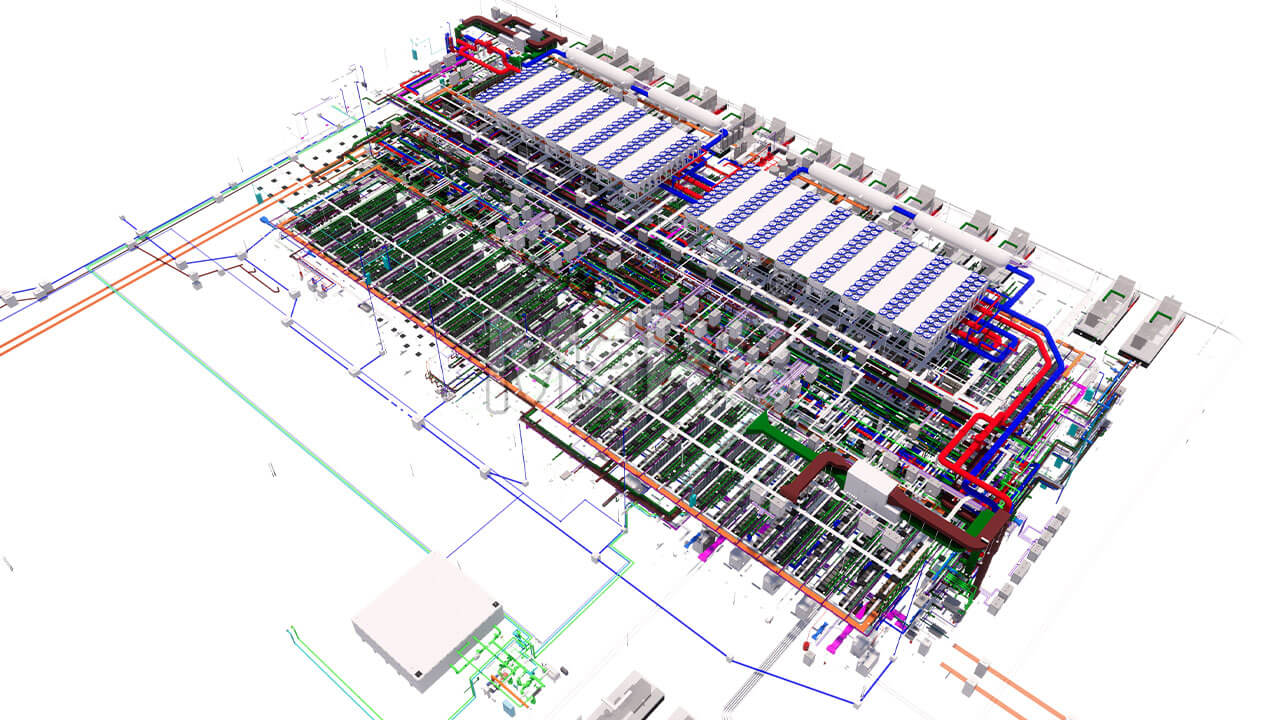
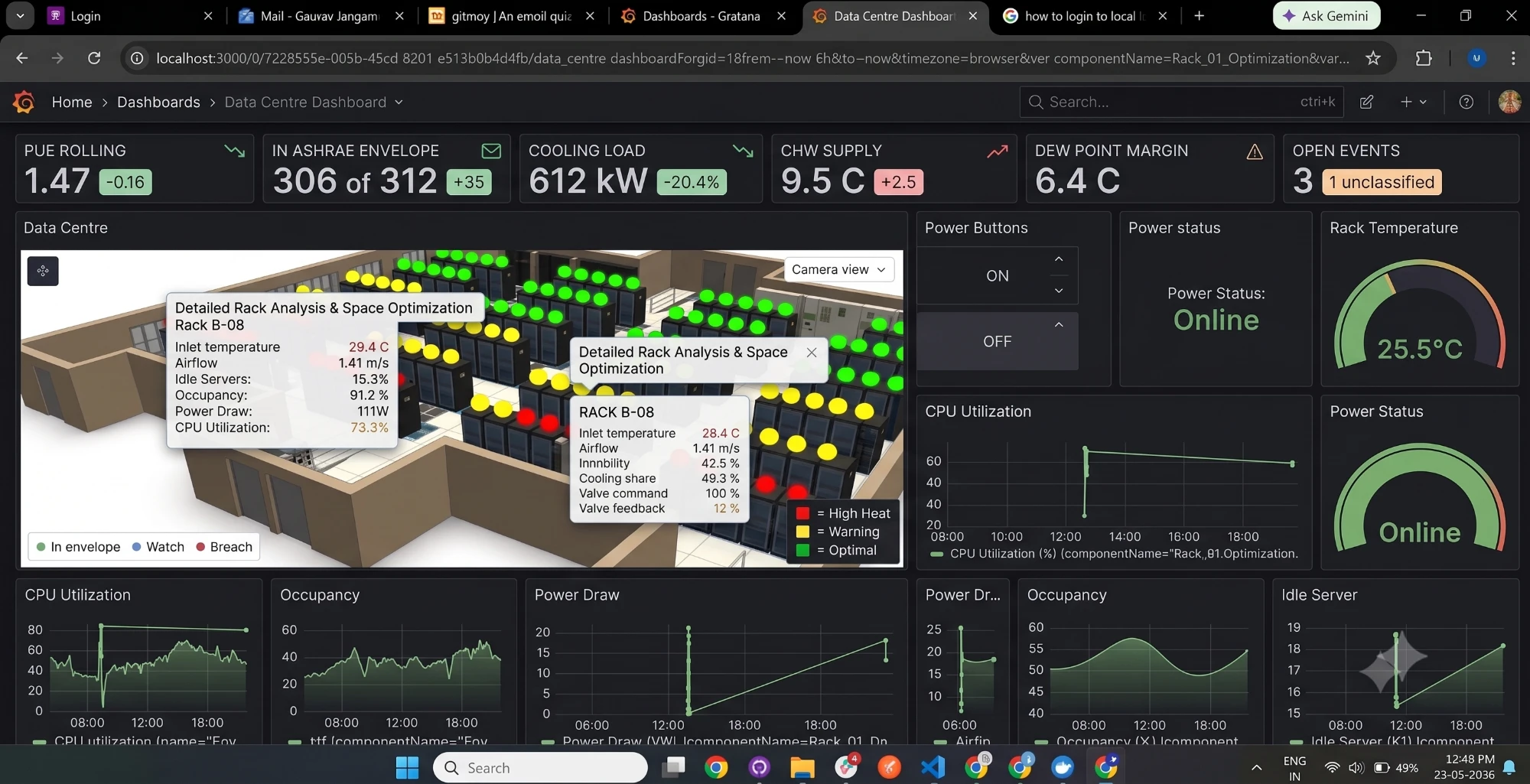
A live operational twin bound to the client’s own Revit model, built so the plant keeps running on its own logic. 1,179 telemetry points across racks, cooling, power and environmental systems: a hot rack is a red rack you can click.
Where the pain concentrates
Data centre operators sit on four systems that each describe part of the hall and none of the whole. The commercial response has been to over-cool everything, until the energy bill arrives.
Four systems, no shared model
Rack environmental data, the BMS, SNMP power polling and a hand-kept asset spreadsheet. Four sources of truth, and no question could cross two of them.
Alarms name a sensor, not a cause
An alarm identified a probe. Working out which CRAH served that row and whether its valve had actually opened took 47 minutes on the floor.
Over-cooling bought as insurance
With no confidence in worst-case inlet temperatures, chilled water sat at 7.0°C and fans at 78%. The rational response to poor visibility, paid for in energy.
A CFD study ages out
A simulation commissioned two years earlier was accurate the day it ran. Load and layout moved. The problem was continuous and spatial; the answer was a snapshot.
What the hall actually sounded like
Advisory twin, BMS keeps control
The Uptime Institute’s 2025 survey makes it plain: operators accept AI for sensor analysis and predictive maintenance, and refuse it for driving equipment. Any design that ignored that was dead on arrival in a Tier III hall under tenant SLAs.
ScroBits built the full stack: battery-powered LoRaWAN sensing at three heights per rack, Greengrass edge acquisition over Modbus / BACnet / SNMP / LoRaWAN with 72 hours of local buffer, SiteWise as the single asset model, the client’s Revit model converted to glTF (14M to 1.9M triangles) for the 3D surface, Lambda + DynamoDB stateful rules, and supervisory controls with allow-listed registers, clamped setpoints, two-person approval and automatic 15-minute reversion.
What runs today is 1,179 live telemetry points bound to the client’s own Revit model, PUE down from 1.63 to 1.47 at comparable IT load, 1.61 GWh/yr of cooling energy saved, and two planned CRAH units cancelled. The BMS still owns the control loop.
The twin recommends, an operator approves, the BMS executes. Unconfirmed overrides revert automatically after 15 minutes. Advisory, not autonomy, is the shippable design.
Five building blocks, one live hall
Each block carries one job in the acquire → model → recommend → approve chain. Together they put the hall on a browser, in place, with the mechanical chain behind every alert already highlighted.
Advisory, never the control loop
BMS keeps full local autonomy. The twin recommends, an operator approves, the BMS executes. Unconfirmed overrides revert automatically after 15 minutes.
Revit, bound to live data
The client's Revit model, converted to glTF 2.0 with Draco compression. 14M triangles down to 1.9M, so the hall holds a live frame rate in a browser with every rack, CRAH and chiller showing its current state in place.
Wireless retrofit at rack level
No cabling windows, no floor-void work. Battery-powered LoRaWAN sensors at three heights per rack front, two gateways per hall for path diversity. Deployed in production without a single rack coming down.
Stateful rules over managed alarms
A hot rack with a valve already open and a feedback signal that has not moved reads as an actuator fault, not a warm room. Multi-condition logic in Lambda + DynamoDB stopped waking the NOC to the wrong problem.
Stranded capacity calculator
Separates "out of cooling capacity" from "capacity in the wrong place", quantified in kW deliverable. Two planned CRAH units were cancelled on the strength of this one view.
Acquire
Modbus, BACnet/IP, SNMPv3 and LoRaWAN into Greengrass, 72h local buffer.
Model
SiteWise asset hierarchy, delta T, RCI and condensation margin defined once.
Bind
Revit becomes glTF, 14M to 1.9M triangles for a live browser frame rate.
Judge
Stateful rules distinguish a hot room from a stuck valve or drifting probe.
Recommend
Operator sees the hot rack as red in place, mechanical chain highlighted.
Act
Allow-listed registers, clamped setpoints, two-person approval, 15-min revert.
Report
Tenant SLA reports, PUE trends and corrosion exposure, same definitions.
Before, after, change
Measured over 90 days post go-live against a 90-day baseline, at plus or minus 3% IT load. Delivered in 22 weeks.
| Measure | Before | After | Change |
|---|---|---|---|
| Racks outside ASHRAE 18-27°C inlet envelope | 41 of 312 | 6 of 312 | -35 racks |
| Time to locate the asset behind a thermal event | 47 min | 6 min | -87% |
| Cooling energy at comparable IT load | Baseline | -20.4% | 1.61 GWh/yr |
| PUE, annualised and load-normalised | 1.63 | 1.47 | -0.16 |
| Chilled water supply temperature | 7.0°C | 9.5°C | +2.5°C |
| Stranded cooling capacity made deliverable | Not measured | 210 kW | 2 CRAH units cancelled |
Extending the twin beyond today’s hall
Each roadmap item follows the same advisory-twin principle: recommend first, approve second, execute inside the plant’s own safety envelope.
Thermal digital shadow
Run ahead of the plant to predict hot spots 15 to 30 minutes before they form.
Capacity-aware deployment
Place new tenant racks against live stranded capacity, not nameplate assumptions.
Automated compliance reporting
ASHRAE and ISA 71.04 reports published directly to tenant portals.
Multi-site rollup
Cross-site PUE and corrosion benchmarking from the same SiteWise definitions.
Workload-aware setpoints
IT telemetry (CPU, inlet, workload class) narrows the envelope per row, not per hall.
Three principles we are taking into the next engagement
Advisory beats control in regulated halls
Nobody lets software drive chillers. The twin recommends, the operator approves, the BMS executes. That one design decision is what let the project ship into a Tier III site under tenant SLAs.
One definition, consumed everywhere
Delta T, RCI and condensation margin defined once in SiteWise. The twin, the Grafana dashboards and the monthly tenant reports all read the same numbers. No reconciliation meetings.
Spatial beats tabular when the problem is physical
A hot rack is a red rack you can click, with the mechanical chain that serves it already highlighted, not a probe ID in a list of 1,179.
Running a hall and want the twin to earn its keep?
ScroBits builds the sensing, the model and the control safety. Two weeks to a coverage map and a build-or-wait answer on your real floor plan and your real BMS.